Tokenizing the London Bullion Market: Turning vaulted gold into programmable institutional collateral

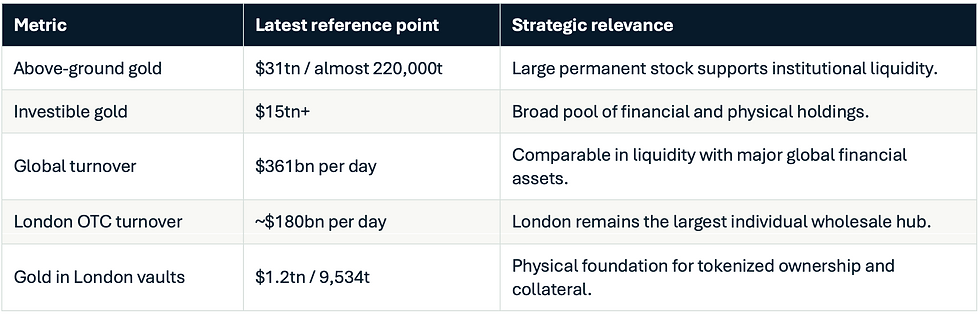
Nearly 220,000 tonnes of gold exist above ground, with an estimated value of approximately $31 trillion. The World Gold Council estimates that more than $15 trillion constitutes the addressable investment market, including bars and coins, physically backed exchange-traded products, over-the-counter holdings, official-sector reserves and gold-related financial instruments.
Tokenizing Bullion Market - London sits at the centre of an unusually large and liquid market
London sits at the centre of this market. Global gold trading averaged approximately $361 billion per day in 2025. London OTC activity accounted for around $180 billion or approximately half of global turnover, compared with $114 billion on COMEX and $51 billion on the Shanghai Futures Exchange.
The most recent London Bullion Market Association data indicate that London’s position remains substantial. Weekly gold turnover reached $942.6 billion on a 12-week moving-average basis through 31 July 2026, equivalent to approximately $188.5 billion per business day. At the end of that month, London vaults held 9,534 tonnes of gold worth approximately $1.2 trillion. This inventory included commercial holdings as well as metal held at the Bank of England for governments, central banks and eligible financial institutions.
The market is therefore large enough that even modest reductions in settlement risk, reconciliation costs or collateral friction could create material aggregate value.
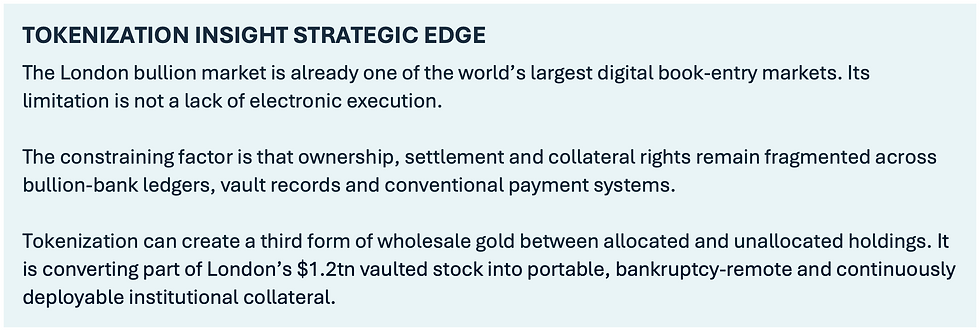
London’s bullion market is already highly digital. The opportunity is not simply to put gold “on a blockchain.” It is to create a legally robust and interoperable ownership layer that combines the property rights of allocated gold with the liquidity and divisibility of unallocated gold.
If properly designed, tokenization could deliver three strategic upgrades:
Create a third ownership model: combine beneficial ownership of physical gold with liquidity, portability and fractional transferability.
Connect gold and cash: enable regulated delivery-versus-payment while preserving the liquidity benefits of netting.
Make gold deployable: allow vaulted bullion to serve as collateral across lending, derivatives, payments and securities markets.
The largest institutional value pool is likely to come from collateral mobility rather than trading alone. The winners will be participants that control trusted custody, liquidity, cash settlement and market connectivity. The greatest disruption will fall on fragmented product wrappers, proprietary ledgers and business models that depend on keeping client assets inside closed account systems.
Today’s market is digital but ownership and settlement remain fragmented
London’s wholesale bullion market operates primarily through the Loco London OTC system. Trades can be executed by voice, dealer platform or API, but the resulting metal and cash obligations generally move through different systems.
A typical transaction involves several distinct operating layers:
Want to read more?
Subscribe to tokenizationinsight.com to keep reading this exclusive post.
