Stablecoin Card Payments Economics at Scale: Who Gets Paid and By How Much?

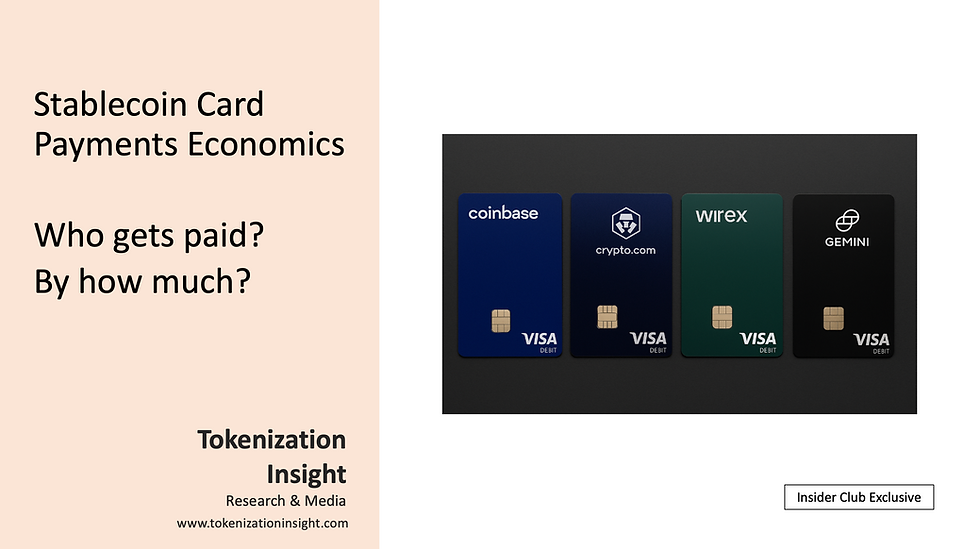
Crypto cards are the new bridge between on-chain value and real-world commerce.
Data analytics firm Artemis estimates monthly crypto card volume grew from roughly $100m in early 2023 to over $1.5b by late 2025, implying an 1,500% increase and an $18b+ annualized run rate.
That trajectory is likely to continue, pulling more stablecoin-enabled settlement volume along with it. But even as “stablecoin-native settlement” expands, it is unlikely to remove fiat from the equation. Instead, it shifts where and when conversion occurs. The more consequential question is elsewhere: whose share of the card payment economics is mostly under pressure and why.
In this week’s research, I break down the mechanics and economics of stablecoin card payments, including:
Where the stablecoin leg actually sits in the crypto card payment flow
What stablecoin-native settlement really means, and why it does not eliminate fiat
Who captures the economics across authorization, clearing, and settlement,
Which revenue pools are most at risk, and for whom
Let’s dive in.
1) Most “stablecoin card payments” are fiat settlement in disguise
Crypto card transactions fall into two paths:
Stablecoin converts to fiat before the transaction reaches the card network
Stablecoins are used to settle obligations at the card network layer
This chart should make the transaction stages clearer.

Visa’s latest disclosed stablecoin settlement activity implies roughly a $4.5b annualized run rate. Against an estimated $18b annualized crypto card run rate, that suggests stablecoin settlement represents around 25% of volume, with the majority still settling through fiat rails.
That is the key point: most “stablecoin card payments” are not settled in stablecoin at all. Stablecoins are typically converted into fiat by the issuer (or its liquidity stack) before the transaction reaches Visa or Mastercard. By the time it hits the network and its members, it is operationally indistinguishable from any other fiat card payment.
For the subset that does settle in stablecoin, the mechanics are straightforward. After authorization and clearing, the issuer settles its net obligation to the network in USDC. The network then credits the acquirer in USDC after deducting network and scheme fees.
But the punchline remains: unless the acquiring side has a balance-sheet use case for stablecoins, it still needs to convert that USDC back into fiat to pay merchants and manage treasury. Stablecoin-native settlement changes the settlement asset and timing, not the end-state reliance on fiat.
2) Stablecoin settlement does NOT eliminate fiat
This is the most important, often overlooked truth about stablecoin card payments: even if settlement between the issuer and the network, and in some cases the acquirer, can occur in USDC, fiat remains the unit of account for most merchants and corporate obligations.
Stablecoin-native settlement does not eliminate fiat. It primarily shifts where conversion happens, moving the stablecoin-to-fiat step from the issuer side to the acquirer or downstream treasury function.
Why fiat still show up?
Operational and regulatory reality forces it:
Merchant settlement and accounting: most merchants want local fiat for payroll, taxes, suppliers, and financial reporting.
Regulatory treatment and risk management: stablecoin balances introduce additional operational, custody, and redemption considerations. Many regulated institutions will treat stablecoins as a settlement instrument, not a permanent treasury asset.
Dispute and chargeback rails: the card ecosystem’s reversibility and dispute processes are fiat-native in practice, even if the settlement asset changes behind the scenes.
So what is the point of stablecoin settled transactions?
The advantage is not “no fiat.” The advantage is always-on settlement. Unlike banking rails constrained by operating hours and cutoffs, stablecoin-native settlement can run 24/7. That improves treasury flexibility, enhances weekend coverage, and reduces the operational friction of timing liquidity around banking windows.
3) Where are the Economics and Who makes what money
The major players involved in the stablecoin card payment economy are:
Merchant
Acquirer
Issuer
Card network
Card issuance program manager
Each makes a cut off the transaction. Below is a simplified table summarizing where economics takes place in the transaction flow.

As we can see the biggest revenue pools are:
1) interchange (collected by issuers)
2) FX markup (collected by issuers in most cases expect when acquirers need to do conversion to merchant settlement currency)
3) Scheme (collected by card networks)
And there is good news and bad news.
The good news for acquirers is that their most defensible profit pool remains intact. Whenever merchant settlement requires converting from the transaction settlement currency into the merchant’s payout currency, the acquirer retains its margin. In the case of stablecoin-settled transactions, that simply means the acquirer earns its normal conversion spread when swapping USDC into fiat, the unit of account merchants still require.
Card networks are similarly well insulated. They retain control of scheme fees, which are driven by merchant type, geography, and risk attributes. Network assessment fees also apply regardless of who the issuer or acquirer is. More crypto cards therefore mean more network volume on the same rails, with minimal incremental operational complexity. It is unsurprising that both Visa and Mastercard are aggressively supporting additional crypto card issuance.
The more meaningful downside help is on the issuing side. While stablecoin-native players generally do not yet have the scale to disintermediate acquirers or bypass the networks entirely, the rise of full-stack stablecoin card issuers with principal membership and integrated technology stacks poses a credible threat to traditional issuing banks’ share of the economics.
The most valuable pools at risk are issuer-side revenues: interchange and, in certain configurations, FX. Players such as Crypto.com, Rain, Wirex, and Reap can capture more of the value chain by combining regulatory permissions with developer-friendly issuance infrastructure. In practice, they increasingly function as “issuance platforms,” enabling exchanges, wallets, and crypto brands to launch white-labelled cards without relying as heavily on sponsor banks.
Examples are already visible. The Avalanche Card is issued and powered by Rain, and TeekPay’s Global Visa Card is marketed as powered by Reap.
Below is an illustrative example to show the order of magnitude of impact on banks and EMIs.
Monthly stablecoin card volume: $1.6b
Effective interchange rate (blended across prepaid, debit, credit, regions): 0.60% to 1.20%
Share of volume involving meaningful cross-border or currency conversion dynamics: 25% to 45%
FX margin captured by issuer or full-stack provider (net of venue costs): 0.25% to 0.75% on the FX-impacted slice
Resulting monthly revenue pools
Interchange pool
Low: $1.6b × 0.60% = $9.6m per month
High: $1.6b × 1.20% = $19.2m per month
FX pool (issuer or full-stack capture, not network fees)
Low: $1.6b × 25% × 0.25% = $1.0m per month
High: $1.6b × 45% × 0.75% = $5.4m per month
In aggregate, banks and EMIs could forgo roughly $100m to $250m of annual revenue (at $18B annualized runrate) if full-stack crypto card issuers gain meaningful share of the issuing economics.
Full-stack players like Rain are actively pushing product innovation to accelerate that shift. One example is Rain’s Credit Loop: a closed-loop receivables financing structure that uses stablecoins as settlement liquidity for card credit programs. Rain works with a network of capital partners, borrowing stablecoins to fund network settlement against credit card receivables, then repaying lenders programmatically as repayment cash flows come in. The result is a more capital-efficient model that can lower the cost of funding for consumer and B2B credit programs while offering lenders stronger collateral visibility and automated repayment mechanics enabled by smart contracts.
Key takeaways for banks and EMIs:
Most stablecoin card payments are best understood as card payments with upstream conversion, not as “on-chain merchant payments.”
Stablecoin-native settlement is real and expanding. Visa’s USDC settlement capability brings 7-day settlement windows and treasury benefits, but it does not remove fiat from the merchant economy.
Networks benefit because they monetize incremental volume on existing rails, and issuers monetize primarily through interchange and, in some cases, FX and conversion economics.
Issuer-related revenue streams likely to be the most negatively impacted space given the emergence of fully regulated issuance stack + tech platforms like Rain and Reap
Disclaimer: This content is for informational purposes only, you should not construe any such information or other material as legal, tax, investment, financial, or other advice.
✅ Explore more research on tokenized funds, stablecoins, tokenized deposits, market infrastructure, and collateral mobility:
Want to understand what matters next. Join Strategic Edge for exclusive research, strategic analysis, and commercialization insights shaping the future of tokenization and digital assets.


Comments